
Neurodivergent-Affirming Therapy for ADHD & Autism

Therapy that works with your brain, not against it.
Some people have always known their brain works a little differently. For others, the pieces only start coming together later.
An ADHD or autism diagnosis can suddenly explain experiences that never quite made sense before. And sometimes there isn't a diagnosis yet, just a growing sense that neurodivergence might be part of the picture.
Either way, therapy shouldn't be another place where you're asked to work harder at being someone you're not.
At Full Self Psychotherapy, we work with teens and adults to understand the whole picture: how your brain works, what your nervous system needs, what you've lived through, and how all of that shows up in your relationships and daily life.
Schedule a Free Consultation
You've gotten really good at looking like you have it together.
Smart. Self-aware. Capable. From the outside, things may actually look pretty good.
But does keeping everything together take way more energy than anyone realizes?
- Hyperfocus for hours on something interesting but struggle to start something you've been thinking about all week?
- Crave structure and resist it at the same time?
- Get completely thrown off by transitions, interruptions, competing demands, or changes in plans?
- Feel overwhelmed by noise, textures, crowds, or other sensory input?
- Rehearse conversations beforehand or analyze them afterward?
- Hold it together all day at work or school, only to completely crash when you get home?
- Accomplish incredibly difficult things and still wonder why you can't just answer that email?
Over time, those experiences can become a story about who you are:
I'm lazy. I'm too sensitive. I'm too much. I should be able to handle this. Why can everyone else do this except me?
Therapy can help separate who you are from what you've learned to believe about yourself.

Our Approach to Neurodivergent-Affirming Therapy
You don't need another planner.
Okay, maybe you do. A really good planner can be soooo satisfying.
Body doubling, timers, medication, routines, external reminders, breaking things into smaller steps, sensory supports, and changing your environment can all help too.
At Full Self Psychotherapy, we use these kinds of practical strategies in our work with clients.
But chances are, you already know a lot of them. Knowing what helps and being able to consistently do it are two very different things.
That's because ADHD and autism don't exist separately from the rest of you.
Executive functioning is only one piece of it. Sensory needs, emotions, relationships, your nervous system, your environment, and what you've lived through matter too.
So instead of spending all of our time figuring out how to make you function the way you think you should, we also want to know:
What does your brain actually need to function well?
Sometimes it's hard to tell where neurodivergence ends and everything else begins.
Being neurodivergent is not the same thing as having trauma. Trauma does not cause ADHD or autism.
But living in a world that doesn't always understand your brain can leave a mark.
For a lot of neurodivergent people, the messages started early:
Try harder. Stop being so sensitive. Pay attention. Sit still. You're overreacting. Why can't you just do it?
Over time, masking can become second nature: reading the room, rehearsing what to say, suppressing your needs, or figuring out exactly what other people expect from you.
Perfectionism can become one way of making sure nobody notices how hard you're working underneath it all.
And sometimes there is trauma alongside neurodivergence that has nothing to do with being neurodivergent.
We don't need to sort every experience neatly into "the ADHD," "the autism," or "the trauma." We can get curious about how all of it fits together.

Neurodivergent-affirming isn't just a label we use.
At Full Self Psychotherapy, neurodivergence isn't something we only understand through professional training. Several members of our team are neurodivergent themselves, bringing lived experience and personal understanding alongside their clinical expertise.
We also pursue specialized training in adapting therapeutic approaches for neurodivergent clients, including neurodivergent-affirming applications of EMDR, IFS, and somatic therapies.
We know there isn't one “right” way to do therapy. Our goal is to create a space where you don't have to mask, explain away your needs, or work against the way your brain functions.
Meet Our Neurodivergent Therapists
For some clients, working with a therapist who is neurodivergent themselves can make a meaningful difference. Our clinicians bring both lived experience and specialized training to their work, creating space for understanding, connection, and therapy that honors how your brain works.
-
Naomi Pomerantz, LICSW, LCSW-C
Naomi works with teens, young adults, and adults navigating trauma, anxiety, neurodivergence, perfectionism, and questions of identity and belonging. She especially enjoys working with autistic and ADHD clients, LGBTQIA+ clients, and people who have spent a long time feeling different or misunderstood. With training in EMDR, Internal Family Systems (IFS), and Dialectical Behavior Therapy (DBT), Naomi combines deeper trauma work with concrete skills clients can actually use outside of therapy. Naomi sees clients in person at our Dupont Circle office in D.C. and virtually in D.C., Maryland, and Virginia.
-

Brendan O'Connell, LMSW, LGSW
Brendan works with teens, adults, and couples navigating relationship struggles, self-worth challenges, and the weight of past experiences. His style is relational and down-to-earth, with a particular focus on helping clients understand the patterns that keep showing up in their lives and relationships. Drawing on advanced training in IFS, EMDR, and Somatic Experiencing, he helps clients move from feeling stuck to experiencing meaningful relief, choice, and connection. Brendan sees clients in person at our Dupont Circle office in D.C. and virtually in D.C., Maryland, and Virginia.
-

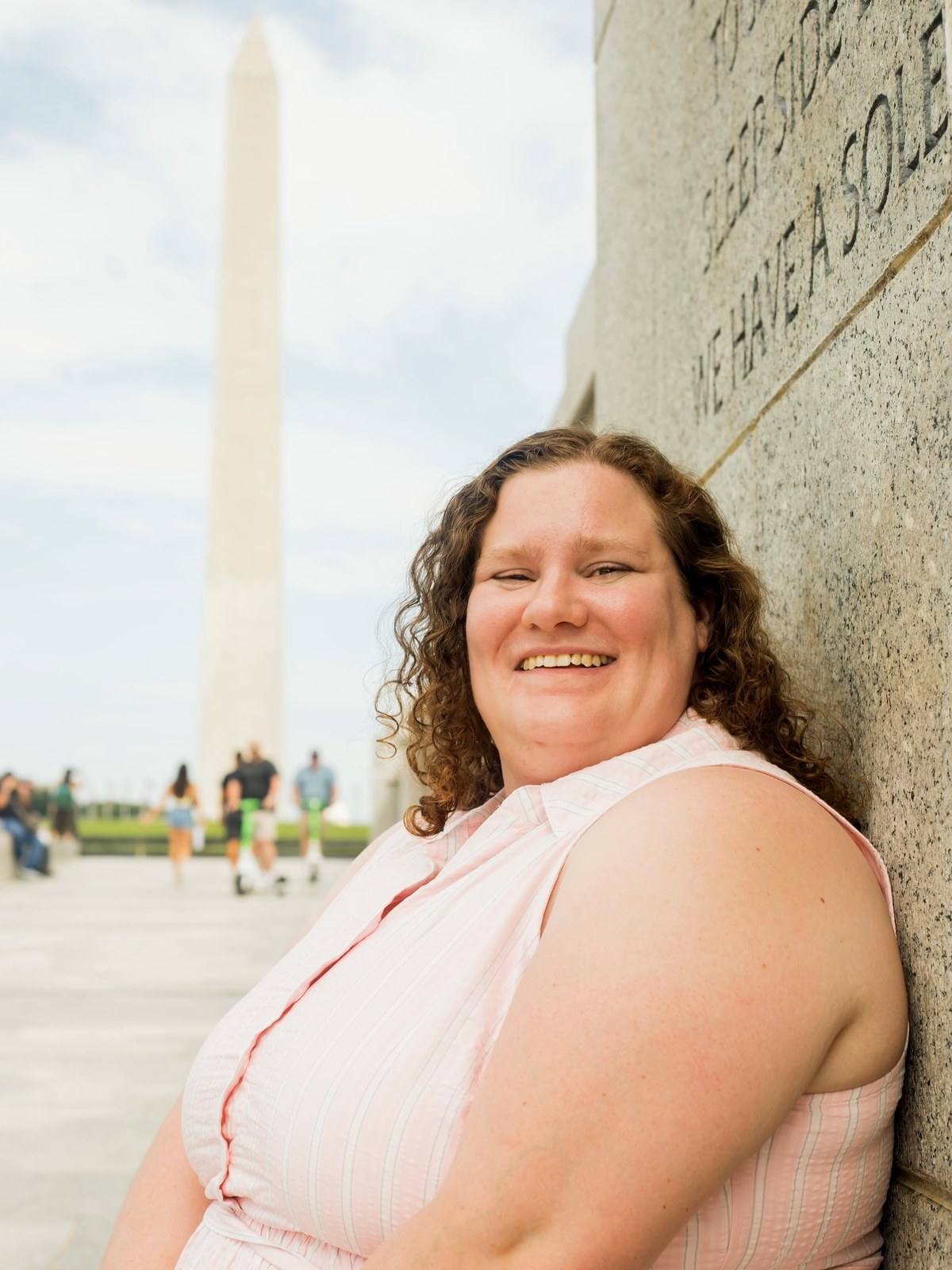
Margot Lamson, LICSW, LCSW-C
Margot specializes in working with neurodivergent adults and teens, perfectionists, and people who tend to have done a lot of therapy or self-reflection but still feel stuck in patterns they understand intellectually. With over 15 years of experience, she uses an evidence-based brain and body approach, integrating EMDR, Internal Family Systems (IFS), and Sensorimotor Psychotherapy to work with patterns that can be difficult to shift through insight alone. She sees clients in person at our Dupont Circle office in D.C. and virtually in D.C., Maryland, and Virginia.
Margot is not taking new clients until end of 2026 or early 2027. Please reach out to Brendan, Molly, or Naomi for current availability.
Therapy That Goes Deeper Than Coping Skills
At FSP, we integrate Internal Family Systems (IFS), EMDR, somatic therapies, and relational psychotherapy into our work with neurodivergent clients. These approaches give us room to work with more than symptoms or behaviors.
-

Internal Family Systems (IFS)
One part desperately wants structure. Another rebels the moment something feels like a demand.
One part wants to start the project. Another is terrified it won't be done perfectly.
One part has gotten incredibly good at masking and keeping everything together. Another is exhausted.
IFS gives us a way to get curious about those different parts. Instead of trying to shut them down or push past them, we can understand what they're doing, why they're there, and what they need.
Learn More About IFS -

EMDR Therapy
EMDR isn't about treating away ADHD or autism.
It can help with experiences that have become tangled up with them: criticism, rejection, bullying, humiliation, difficult relationships, or years of feeling like you were somehow getting things wrong.
EMDR can help us work with the experiences underneath beliefs like I'm lazy, I'm difficult, I'm too much, or I can't trust myself.
Learn More About EMDR -

Somatic Therapy
It's easy to spend so much time in your head that you don't notice what's happening in your body until it gets loud.
Hunger, tension, exhaustion, overstimulation, or the feeling that you're approaching your limit can be easy to miss until your body is practically screaming for your attention. Or everything can feel intensely physical without it always being clear what your body is trying to tell you.
Somatic therapy helps you become more familiar with your body's cues, recognize overwhelm earlier, and figure out what actually helps you feel more grounded and regulated.
And regulation doesn't always mean learning to tolerate more.
Sometimes it means realizing: Actually, this is too much. I need something different.
Learn More About Somatic Therapy

What if 45-minute therapy isn't the best format for your brain?
If you have ADHD, you know how frustrating it can be to finally get focused on something...and then have to stop.
Traditional weekly therapy can sometimes feel like that. Just as things start to click and the conversation gets somewhere meaningful, the session is over.
Then the next week, you have to find the thread again.
That's one reason FSP offers therapy intensives.
Longer sessions leave more room to settle in, follow where your brain naturally makes connections, take breaks when needed, and stay with something long enough to actually get somewhere.
For someone who takes a little while to get going but becomes deeply focused once engaged, more time can be a really good fit.
Explore Therapy Intensives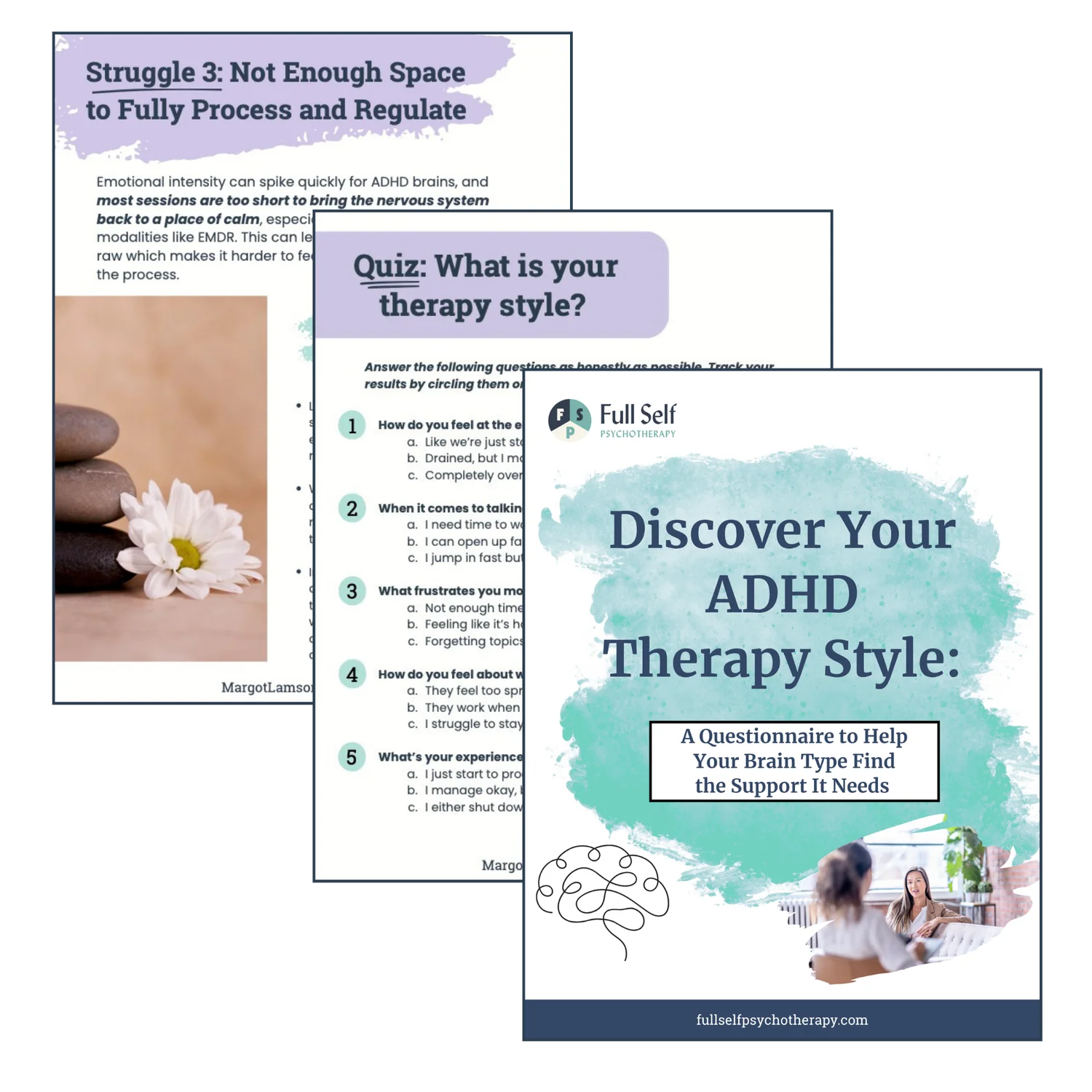
Finally, Therapy That Makes Sense for Your ADHD Brain
Ever felt like you're "bad at therapy"? It may be worth looking at the format of therapy itself.
Our free guide, Discover Your ADHD Therapy Style, explores different ways ADHD brains engage in therapy, including why having more time to go deeper can work better for some people.
Grab Your Free Guide
What Can Neurodivergent-Affirming Therapy Help With?
- Understand your brain in a way that actually feels useful.
- Catch sensory overload and burnout before you've completely hit the wall.
- Find systems that work with your executive functioning.
- Untangle procrastination, task paralysis, and perfectionism from years of shame and self-criticism.
- Work through trauma, rejection, and experiences of feeling misunderstood.
- Navigate relationships and boundaries with less masking.
- Get better at knowing what you need and trusting yourself enough to honor it.
From the blog
Read more about ADHD and neurodivergence on our blog
 ADHD
When ADHD Medication Isn't Enough: Healing the Emotional Side of ADHD
July 27, 2026
 ADHD
What to Expect in a Therapy Intensive: A Neurodivergent-Friendly Approach to Deep Work Without the Wait
February 3, 2026
 ADHD
ADHD Paralysis Is Not Laziness: Why Starting Feels Impossible, and How Therapy Can Help You Get Unstuck
November 25, 2025
 ADHD
ADHD in Relationships: Repair Without Self-Abandonment
November 18, 2025
 ADHD
What Makes a Therapy Intensive ADHD-Friendly? Key Features That Actually Work for Neurodivergent Brains
September 16, 2025
 ADHD
Anxiety and ADHD: Why They Often Go Together, and How Therapy Can Help Untangle Them
August 4, 2025



You Don't Need a Diagnosis to Start Therapy Here
Some people come to us knowing they have ADHD or autism. Others have spent years wondering why certain things seem to take so much more effort for them than for everyone else.
A perfect label isn't required.
Therapy can be part of figuring out what fits. And if a formal evaluation would be useful, we can help connect you with trusted providers who specialize in ADHD or autism assessment.
FAQs About Neurodivergent-Affirming Therapy
Do you work with both ADHD and autism?
Yes. We work with neurodivergent teens and adults, including people with ADHD, autism, or both. The goal is to understand how your brain works rather than assume what a diagnosis looks like.
Do I need an official diagnosis?
No. People come to us with diagnoses, questions about whether they're neurodivergent, or a late diagnosis that's changing how they understand themselves.
Can you diagnose ADHD or autism?
Therapy is different from a comprehensive diagnostic evaluation. If formal assessment would be helpful, we can connect you with trusted specialists.
Is neurodivergent-affirming therapy just about accepting everything as it is?
No. ADHD and autism can create real challenges with executive functioning, task initiation, emotional regulation, sensory overwhelm, communication, relationships, and everyday life.
The goal isn't to pretend those challenges don't exist. We want to figure out what actually helps. That can mean building concrete skills, working through trauma or shame, or looking at what needs to change in your environment, not just what needs to change in you.
Do you work with trauma and neurodivergence together?
Absolutely. This is a big part of the work we do at FSP. Trauma and neurodivergence are different, but they can overlap. We can work with both without assuming that your neurodivergence is something that needs to be healed.

You Don't Have to Work This Hard to Be Someone Else
Therapy can help you understand yourself, heal what has hurt, and figure out what actually works for your brain and your life.
Schedule a Free ConsultationIn-Person Therapy in Washington, D.C.
For some people, getting out of the house and into a space specifically designed for therapy makes it easier to settle in and focus. Our Dupont Circle office offers a comfortable, private setting for neurodivergent teens and adults who prefer meeting with their therapist face-to-face.

Virtual Therapy: Healing from the Comfort of Home
Sometimes home is exactly where your nervous system wants to be.
Virtual therapy can make care easier to fit into an already full life, while also allowing you to meet from a familiar environment where your own sensory supports, comfort items, pets, and routines are close by.
No commute. No navigating a waiting room. No rushing across town and trying to regulate yourself before the session even begins.
Sessions are held through a secure, HIPAA-compliant video platform, giving you the flexibility to engage in therapy from a private space that works for you.
Learn More About Virtual TherapyFollow Us on Instagram
Practical ideas, reflections, and a look at the real people behind the practice. @fullselfpsychotherapy